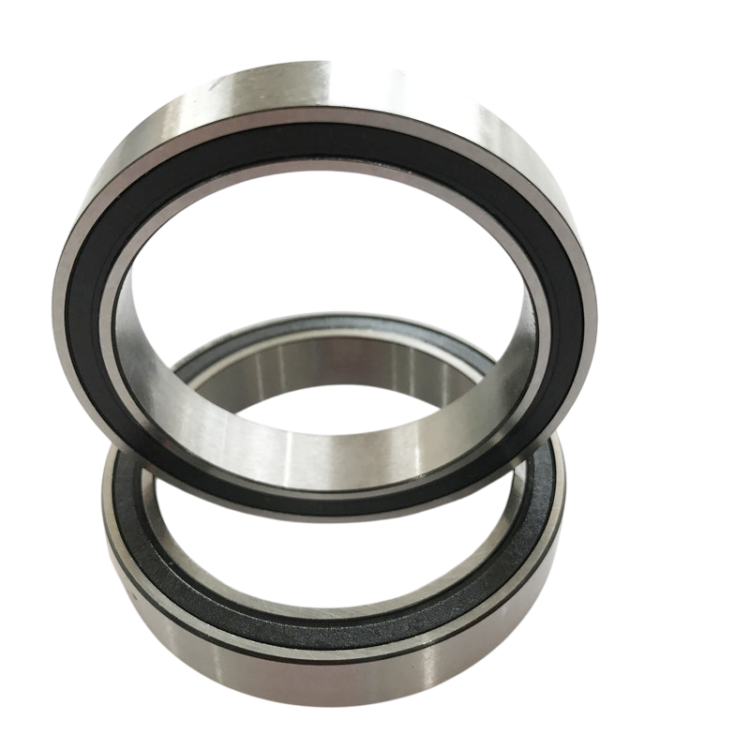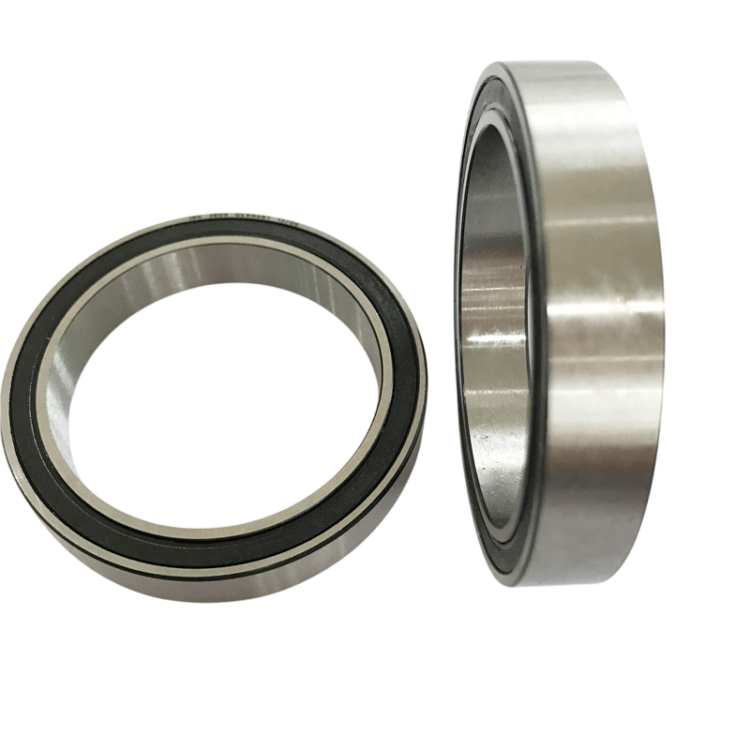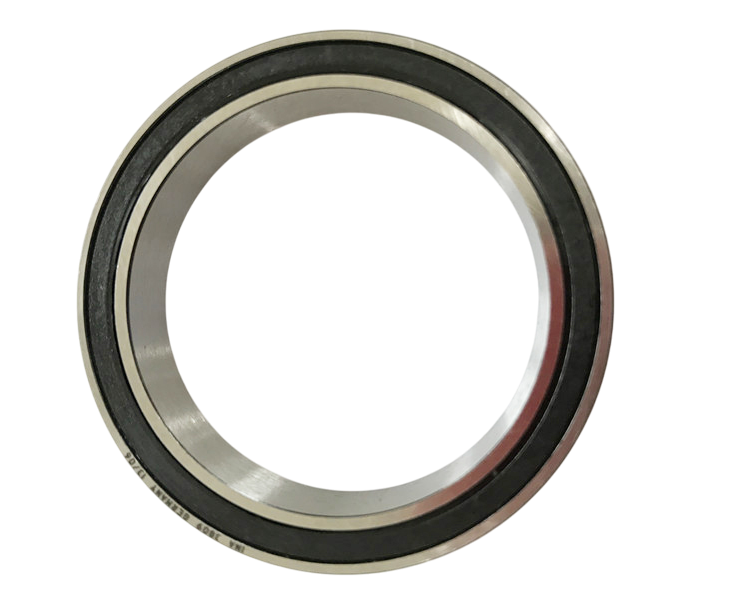
Angular contact ball bearings carry combined radial and axial loads because the line of action through the balls is offset from the radial plane. That offset is the contact angle: 15, 25 or 40 degrees. The larger the angle, the greater the axial capacity and the lower the attainable speed.
Contact angle. A 15 degree bearing suits high-speed spindles and electric motors with light axial load. A 25 degree bearing is the general-purpose compromise for machine tools and pumps. A 40 degree bearing is used where axial load dominates and speed is moderate, such as gearboxes and screw drives. Designation suffixes follow the maker: C or AC or B in the SKF system, C or A or B in the NSK system, so confirm against the original part number or drawing.
Arrangements. A single-row angular contact bearing carries axial load in one direction only, so it is almost always used opposed by another bearing. Back-to-back (DB) places the wide faces together and gives the highest resistance to tilting moments, which suits spindles and gearbox shafts. Face-to-face (DF) places the narrow faces together and tolerates more misalignment with lower moment rigidity. Tandem (DT) doubles axial capacity in one direction. Matched pairs are supplied with light, medium or heavy preload; preload raises rigidity and running accuracy at the cost of heat and reduced speed.
Series and precision. The 70xx series is extra light for high speed, 72xx is light, 73xx is medium with higher capacity, and the 32xx and 33xx series are double row. Precision grades follow ISO 492 and ABEC: P0, P6, P5, P4 and P2. Spindle applications normally require P5 or better, and for matched sets the grade applies to the pair rather than to a single bearing.
Speed and lubrication. Limiting speed depends more on lubrication than on the bearing itself. Grease gives the lowest figure, oil circulation a higher one, and oil-air or jet lubrication the highest. Always quote the lubrication method together with the speed requirement.
Selection checklist. Confirm contact angle for the axial to radial load ratio, single or paired or double row configuration, preload class for pairs, precision grade and runout tolerance, speed with lubrication method, shaft and housing fits including thermal growth direction, and whether sealing is required.
Send the part number or drawing and we confirm dimensions, contact angle, arrangement and lead time within 24 hours.
Not sure which series fits? Send your part number or drawing - we will cross-reference it and reply within 24 hours.


 Message